Monday, October 22, 2012
The Romantic Tough's school of Writing
During the excerpt of short story ideas in the Yellow notebook, one of the stories breaks the naming convention of the other but also appears to break the thematic pattern of the other stories: "19 The Romantic Tough School of Writing" (page 539 in my weird edition).
I say it "appears" to break away from the themes of the other story ideas because it is one of the only stories in which the central speaking voice is male. In fact the narrator of this little story is Mike-the-lone-walker. While the gender of the main speaker has changed, it is worth noting that in at least one of the other short story ideas, one of the female characters is referred to as Anna, and another is an artist. With that in mind, it might not be too great a stretch to place Anna in the central role in all these short story ideas. Thus, we might even say that the nick name "the loan walker" might be linked to the idea of a free woman which Anna represents (or possibly her isolation).
The story also features a mixing of brutal physical violence with professions of love In that the boys, Buddy and Dave, say "I love you man" before pounding the other into unconsciousness. Considering that all the other story summaries involve people "in love" who proceed to emotionally wound each other, one might argue that the "romantic tough school of writing" is a parody of the other stories' cycle of love and emotional pain played out with physical violence.
With that context in mind, Buddy's declaration of love for the girl Rosie, implies that this cycle is played out in the adult world, though in a manner more akin to the other stories.

Friday, October 19, 2012
From the blog of The London Review of Books. Seems relevant to our discussion of The Golden Notebook:
When I was 19 I worked in the production department of Granada publishing. One December evening I went out with one of the editors intending to go for a meal. He said he wanted to stop off at a Christmas drinks party for publishers. When we arrived at the club in which it was being held, I wasn’t allowed into the room, where I could see a hundred or so men, some of whom I knew, drinking, smoking and talking. My companion said he hadn’t realised that it was a men-only party, and that I should wait outside the room while he went in for a quick drink. I said I wouldn’t be doing that and walked in with him. There was a sudden hush in the room, then everyone tried to carry on as if nothing had happened and I wasn’t there. No one spoke to me, and soon I was asked to leave by some official, not because I hadn’t been invited, but because ‘women weren’t allowed’. I said no. My companion insisted that we leave. He was getting anxious. We went, but I skipped dinner.
The next day I was called in by the head of the department (the one with the filing for the bottom drawer) and told off; shouted at, actually. He had been at the party, too. I had behaved ‘very badly and immaturely’. ‘People’ in the profession had been embarrassed by my childish stunt. I was warned I had better not show up the company again.
Even if the underlying contempt for women has not exactly disappeared (read the tabloids, look at trolling on the internet), it is one of the great social improvements of the 20th century that it must be almost impossible for a young woman now to imagine a time within living memory when the superiority and dominance of men was so completely embedded into the normality of the world that I was faced with a man’s seething indignation simply for having walked into a room full of them.
Learning to Deal with Loathsome Men
10 October 2012
If
you lived through the 1960s and 1970s, and are a woman, it’s really
hard to be shocked or surprised by the tolerated sexism back then that’s
currently crawling out of the woodwork. It wasn’t in the woodwork at
the time. It was just there, in the air you breathed, in the world you
walked about in. It wasn’t just DJs and comedians. It wasn’t even only
the touching up, the comments, the boss who called you in to deal with a
pile of filing that needed putting away in the bottom drawer of the
cabinet right opposite his desk (think 1960s miniskirts). The men who
felt you up on the Tube at least knew they were doing something wrong,
even though they didn’t think it was very wrong, or only wrong because
it was in public. You could say, in a loud voice, ‘Take your hand off my
body,’ and they would look ashamed. You could strategise to avoid those
you knew were trouble, you grew a tough skin walking about the street
being shouted at, having your body commented on, being sneered at when
you didn’t respond. Learning to deal with loathsome men in public and at
work was part of being a young woman. But it was more pervasive than
that.When I was 19 I worked in the production department of Granada publishing. One December evening I went out with one of the editors intending to go for a meal. He said he wanted to stop off at a Christmas drinks party for publishers. When we arrived at the club in which it was being held, I wasn’t allowed into the room, where I could see a hundred or so men, some of whom I knew, drinking, smoking and talking. My companion said he hadn’t realised that it was a men-only party, and that I should wait outside the room while he went in for a quick drink. I said I wouldn’t be doing that and walked in with him. There was a sudden hush in the room, then everyone tried to carry on as if nothing had happened and I wasn’t there. No one spoke to me, and soon I was asked to leave by some official, not because I hadn’t been invited, but because ‘women weren’t allowed’. I said no. My companion insisted that we leave. He was getting anxious. We went, but I skipped dinner.
The next day I was called in by the head of the department (the one with the filing for the bottom drawer) and told off; shouted at, actually. He had been at the party, too. I had behaved ‘very badly and immaturely’. ‘People’ in the profession had been embarrassed by my childish stunt. I was warned I had better not show up the company again.
Even if the underlying contempt for women has not exactly disappeared (read the tabloids, look at trolling on the internet), it is one of the great social improvements of the 20th century that it must be almost impossible for a young woman now to imagine a time within living memory when the superiority and dominance of men was so completely embedded into the normality of the world that I was faced with a man’s seething indignation simply for having walked into a room full of them.
Thursday, October 18, 2012
"And so?"

My allusion/reference also comes from this scene. The group is in a kopje full of barricades built by the Mashona in defense of the Matabele. These two groups were native tribes to Rhodesia, and the Matabele attacked and killed many Mashona until Britain began to protect the Mashona. The Matabele were known for taking Mashona women captive as sexual prizes. On page 403, Paul says "Imagine... Here we are, a group of Mashona besieged. The Matabele approach, in all their horrid finery. We are outnumbered." Paul puts the group into the perspective of the victims, not the conquerors. I wondered why he chose to take that perspective and what he thought the looming danger was. I'm still not totally sure. What I did infer, however, had to do with the plight of women at the time. Anna and Maryrose both say they would rather kill themselves than be sexually imprisoned like the Mashona women (403). The men, however, assert that women love them "all the more for our brutality" (411). Obviously, the men here aren't listening to what the women say. The women would rather die than lose their freedom, but the men seem to believe that men that are warlike (taking women captive) are also virile and loved by the captured women. These two conflicting perspectives cannot both be true, can they? Are the problems in the novel's relationships because the men don't take enough control, or because they take too much? Love is submissive, and Anna would rather die than to submit.
As Mrs. Marks would say, "And so?"
Tree of Codes & Kaffir
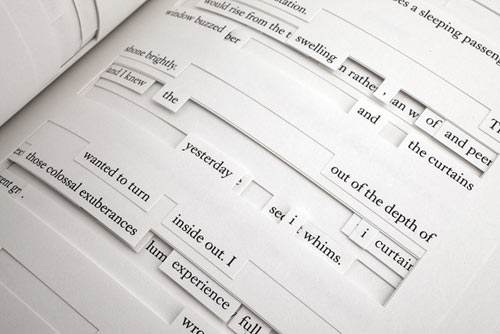
In conceptualizing the notion of a truly mad or chaotic book in relation to an image, I thought of Jonathan Safran Foer's recently published novel/artwork, Tree of Codes. Though I've not had the privilege of reading it, I've heard quite a bit about it. To create this work, Foer cut out the majority of words from Bruno Schulz's Street of Crocodiles in order to fashion a new story (allowing words from successive pages to fill in the blanks left from the cuts -- the attached image should help with visualizing it). This provides for a plethora of interpretations and implications. It is sort of overwhelming to think about. Each page can be read through an altered ostensible scope of Schulz's original intentions or through Foer's potentially haphazard or ingenious manipulation.
For my sociopolitical illusion of choice, I selected Anna's reference to the word "kaffirs":
--"Just as the word kaffirs would have become, in its turn, too crude in ten years' time." (96)
The word is derived from the Arabic word, "Kafir", which roughly translates to English as "non-believer" or "disbeliever". Though originally a neutral term for referring to South African black people, by the 20th century it was considered an offensive ethnic slur.
Experimenting Madly...right?
I chose this image to represent the cracking up theme in the novel because I liked the period it represented and that both subjects in the image are women. I feel this is a stereotypical example of how women are viewed when they "crack up."


As for my reference I chose the reference to Mayakovski early on in the novel. He was a Russian and Soviet poet and playwright. He was one of the people at the head of Russian Futurism.
Waddlin'

So, I drew these pigeons in class today during our close reading discussion. Something I quite enjoy about the passage on page 393 is its first sentence: “Today on the pavement a fat domestic London pigeon waddling among the boots and shoes of people hurrying for a bus.” The structure of this sentence mimics - or displays in another way - the image the sentence describes. This opening line is not a complete thought, but a series of thoughts strung together to reveal the feeling of chaotic streets, the motions of both men and birds. How do their (human footsteps & bird feet) rhythms match or interrupt each other? The language replicates the waddling movements of the birds; it is a chunky and clumsily organized sentence that is still read as an eloquent description of one London moment. I believe it is a great example of form as it mimics image, and one of my favorite images/ language bits of The Golden Notebook so far.
Also, an unrelated question/ thought that will backtrack some -- I have been into the idea of boulders // mountains for a while (from page 199). "The boulder is the truth that the great men know by instinct, and the mountain is the stupidity of mankind." Does this mean that truth is relative but stupidity/ ignorance is more solid/ lasting? That people are able to believe different truths at different times (because "we push the boulder") but we can not change who or what is "stupid"? I am curious to hear any thoughts about this boulder/ mountain issue...if it is even a relevant passage to bring up.
Judge, Jury, and Executioner

Allright, so this was probably my fault for not being clear about our presentation today, my bad, but here is something that I thought about the passages that we talked about today. I felt that these passages contained a theme that is present throughout most of the novel. The theme is that people seem to often miss apply a false sense of authority, or rather, they make judgements and actions hastily based on what they believe to be true about what they're doing, and what they believe is true about what other people are doing or will do, and end up making a mistake and regretting it. Take for example the man who kicks the pigeon. If the man was being honest, that he assumed that the pigeon was just going to fly away, then he demonstrates that people in the novel act without thinking, based on some assumption that they take to be true at the time, and cause destruction, death, and other problems. The man believes the pigeon will fly away, he believes this gives him the right to kick, his assumption turns out to be wrong, the pigeon dies, and he is hated by those around him.
Merely sticking to humans interacting with the animal world, this occurs again when Paul and Jimmy notice two pairs of grasshoppers mating among the swarm. They instantly judge the creatures based on their size and assume that the two pairings are "grotesque", and Paul decides that it is his responsibility to "correct" this flaw in nature. And yet, even after he and Jimmy have successfully switched the two pairs so that they match up more in size, the bigger with the bigger, smaller with smaller, the way in which the one on top then switches with the one on top indicates that, in doing so, they may have actually pared them incorrectly, and that they may have, in the process of "correcting" a perceived flaw in nature, they may have ended up creating another one.
But these interactions of the human world botching up the animal world also relates to how the human characters have been acting towards each other. even from the very beginning when Molly, Anna, and Richard are discussing what's"best" for Tommy we see that these people are constantly forcing their own opinions and what they believe to be correct on others, and on many occasions, such as when Tommy ends up putting the three to shame when they try to tell him what's best for him, or how Anna and Molly lament that their time in the party was a waste of time. And the fact that this happens in the beginning of the novel, as well as in the Black notebook, if the notebook is to be believed, shows that Anna has done this multiplt times without ever having learned her lesson.
Subscribe to:
Posts (Atom)